A grounding mat for your desk goes under your feet, connects to the earth of a wall socket and only conducts while your bare skin is touching it.
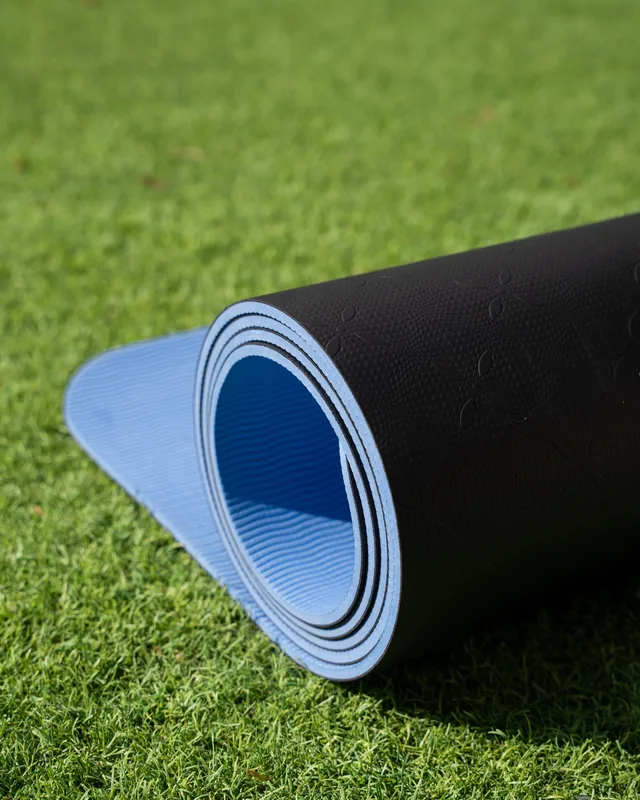
Short answer: it's the same technology as the grounding mat people already use for yoga and meditation, applied to a different setting: not a 20–60 minute session with continuous contact, but a working day with on-and-off contact — you get up, jump on a video call, shift position. This guide explains what changes with that kind of use, and what doesn't.
Does a grounding mat under your desk make sense if you work from home?
Short answer: yes, as a use case — with one real difference from other times of day: during a yoga session your contact with the conductive surface is continuous, and in bed on the sheet it lasts all night; at your desk it's intermittent, because you're constantly moving, standing up and stepping off camera.
If you spend long hours working indoors, it's normal to go through the day with rubber or synthetic soles between your feet and the floor, on surfaces that don't conduct (parquet, laminate, carpet, tiles on an insulating base). That isn't a health problem in itself — it's simply why, if you want to recreate at your desk the same skin-to-earth contact you'd get standing barefoot on damp grass, you need a conductor in between. A grounding mat does exactly that job: nothing more, nothing less.
We don't promise that this particular use will improve your focus, your tiredness or your productivity. Nobody has studied the specific effect of working with your feet on a grounding mat during the working day; what does exist is research on grounding in general, which we cover honestly further down and in our look at what the science actually says about grounding.
How do you set up a grounding mat under your desk, step by step?
Short answer: roll it out where your feet rest, plug the included cable into the earth terminal of a Schuko socket with a real earth connection, and check conductivity with the included tester before you start using it — the same procedure as with any other grounding product in our range.
- Roll the mat out where your feet rest, under the desk. It measures 182×61 cm — the size of a yoga mat — so in a standard desk footwell it's normal for it to sit partly folded, or for you to use only half of it; what matters is that the spot where your feet actually land sits on the conductive surface, not covering the whole floor.
- Watch the cable route so it doesn't end up under your chair's castors or across your walkway: the same common sense you'd apply to any peripheral cable.
- Connect the cable to the earth terminal of a Schuko socket with a real earth connection. If you're not sure how to find the earth terminal, or whether your wiring has one, we walk you through it in how to connect a grounding product to a Schuko socket (the guide uses the sheet as its example; the method is identical for the mat).
- Run the included continuity tester before first use and repeat it every so often, especially if the mat has recently been cleaned.
- Work as normal, resting the soles of your bare feet on the conductive surface while you're seated; contact breaks every time you stand up or cross your legs, and that's an expected part of use, not a product fault.
The Vitality mat comes with a cable and a continuity tester, so you can check for yourself that the silver thread is still conducting.
See the Grounding Mat (€160)Does it work with socks or shoes on at the office?
Short answer: no. Transferring potential requires direct skin contact with the conductive surface: bare feet or bare hands. With socks or thick clothing in between, the effect is reduced or lost, because the fabric acts as an insulator between your skin and the conductive thread.
This is where it pays to be honest about the real friction of using this at work. At home, in slippers you kick off when you sit down, it's easy. In a shared office, with back-to-back video calls and no habit of going barefoot in front of colleagues, it's far less practical — and in winter, with cold feet, it isn't very appealing either. That's why the use case that genuinely makes sense is working from home, rather than the corporate office: it's where you can slip your shoes off without a second thought while you work. And if you're looking at an earthing mat for the office, the logic is the same: no bare-skin contact, no conduction, wherever you decide to use it.
Does it work with a standing desk?
Short answer: yes, in terms of mechanism. The mat is a passive conductor: what determines electrical contact is your skin touching the conductive surface, not your posture. Switching between sitting and standing doesn't change that connection, as long as you keep your bare feet on the mat.
We don't claim that standing on the mat is more effective than sitting — that isn't verified and it isn't in the product's technical specification. From a mechanism point of view, the only thing that matters is skin-to-surface contact; the rest is personal preference about the ergonomics of your workstation, which isn't something a grounding mat can promise.
Mat by day and sheet by night, or just one?
Short answer: they're two products for two different use cases, not an either/or choice: the mat (€160) is designed for the hours when you work, do yoga or meditate; the grounding sheet (€99.99) for the hours you sleep. Which one you need depends on which part of the day you want to cover, not on which one “works better”.
This is a catalogue decision, not a promise of results: there is no study measuring the combined effect of using both products, and we're not going to invent one. If your real question is which of the two to buy first, the table below sets them side by side on price, time of day, contact, size, material and what's in the box — here we simply wanted to make clear that, if you work from home and also sleep, each product covers a different part of the day, with no overlap.
| Criterion | Grounding Mat | Grounding Sheet |
|---|---|---|
| Price | €160.00 | €99.99 |
| Time of day | Working day, yoga, meditation | Sleep (all night) |
| Skin-to-surface contact | Intermittent (you stand up, step away for video calls) | Continuous, several hours at a stretch |
| Size | 182 × 61 cm | Single fitted sheet |
| Conductive material | Woven silver thread | 5% silver |
| Included | Cable + continuity tester | Cable + adapter + 2 testers (continuity and socket earth) |
| Product page | See the mat | See the sheet |
Why conductive silver and not another material?
Short answer: because it conducts far better from day one. According to standard electrical conductivity values at 20 °C (NIST, Engineering Toolbox), silver reaches ~63×10⁶ S/m versus ~1.4×10⁶ S/m for 316L stainless steel — roughly 45 times more. Steel is cheaper and doesn't tarnish; we prefer silver's conductivity and biocompatibility.
The Vitality mat has conductive silver thread woven into its surface. You can see the full materials comparison, with the real pros and cons, in silver vs stainless steel in grounding. And as with any conductive thread, use and cleaning can wear it down over time: that's why the mat includes a continuity tester, so you can check for yourself that it's still conducting before you rely on it.
The limits of the evidence: what this mat doesn't promise for your working day
Short answer: a grounding mat is not a medical device, doesn't diagnose or treat any condition, and doesn't replace active breaks, a well set-up workstation or advice from a healthcare professional. There is published research on grounding in general, but no study specifically on its use during a working-from-home day.
The benchmark review in the field is by Chevalier, Sinatra, Oschman and colleagues (Journal of Environmental and Public Health, 2012), which brings together earlier studies on earthing and proposes electron transfer as a physiological mechanism. It's a narrative review of small studies, not a large-scale clinical trial: in our editorial assessment, the evidence is still preliminary. You can see that and the other references, each with its limitation flagged, on our grounding studies page (in Spanish); and a full breakdown of what the science backs and what it doesn't in Grounding: real effect or placebo?
None of those studies specifically measures the use of a grounding mat during hours of seated work, or compares working days with and without one. We don't promise less tiredness, sharper focus or less discomfort from sitting: those are claims we can't back with anything verifiable, and we'd rather say so plainly than inflate what the product can offer.
A grounding mat for your everyday routine
If you work from home and want to recreate at your desk the same contact with the earth you'd have barefoot outdoors, a grounding mat does that one specific job: a passive conductor, no batteries, no electronics, verifiable with the included tester. It isn't a promise of better performance at work — it's one more piece in a bioelectric wellness routine, with its limits stated up front.
Frequently asked questions (FAQ)
Founder of Vitality Life Balance and BioWell (bioquantum) accredited. He has spent years testing and measuring grounding equipment, and writes based on the published grounding studies, limitations first. He is not a healthcare professional: this content is informational and does not replace medical advice. You can read his story here.
Want to recreate contact with the earth during your working day? Discover the Vitality Grounding Mat — €160.00.
Keep reading on Vitality Research
The earth-only adapter step by step, and what to do if your socket has no real earth.
Why we chose silver: conductivity, plus the real pros and cons.
The real studies and their methodological limits, no exaggeration.