1 · Skin
Your skin is a battery. Vipassanna forms another one when it touches it.
In 1982, a voltage difference of between 30 and 100 millivolts between its two faces was measured in the hairless skin of a mammal (the guinea pig). A year later, in 17 volunteers, voltages were measured across human skin, comparable to those of other mammals and varying by body area. The authors put forward hypotheses about their function, without proving them.
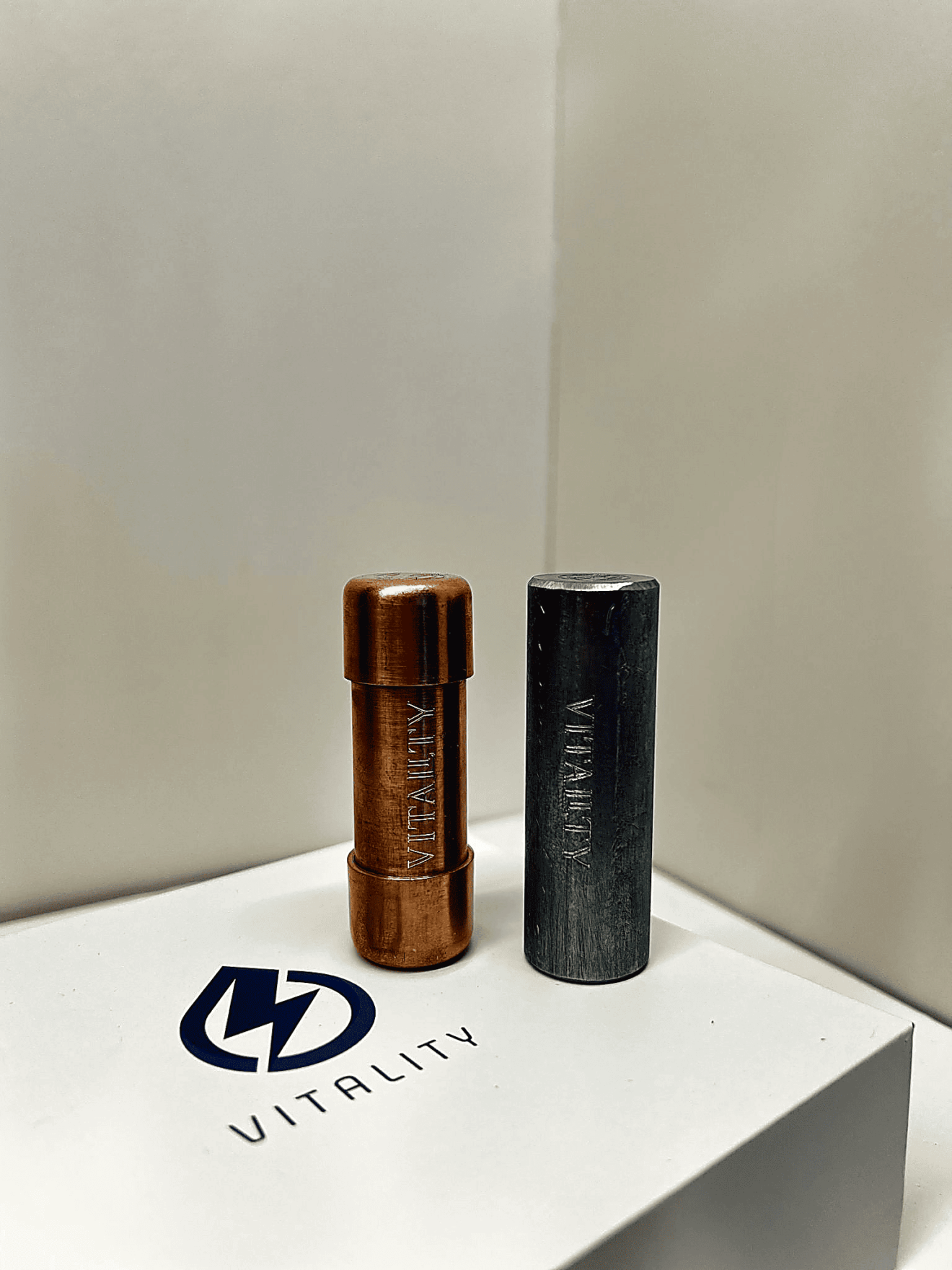
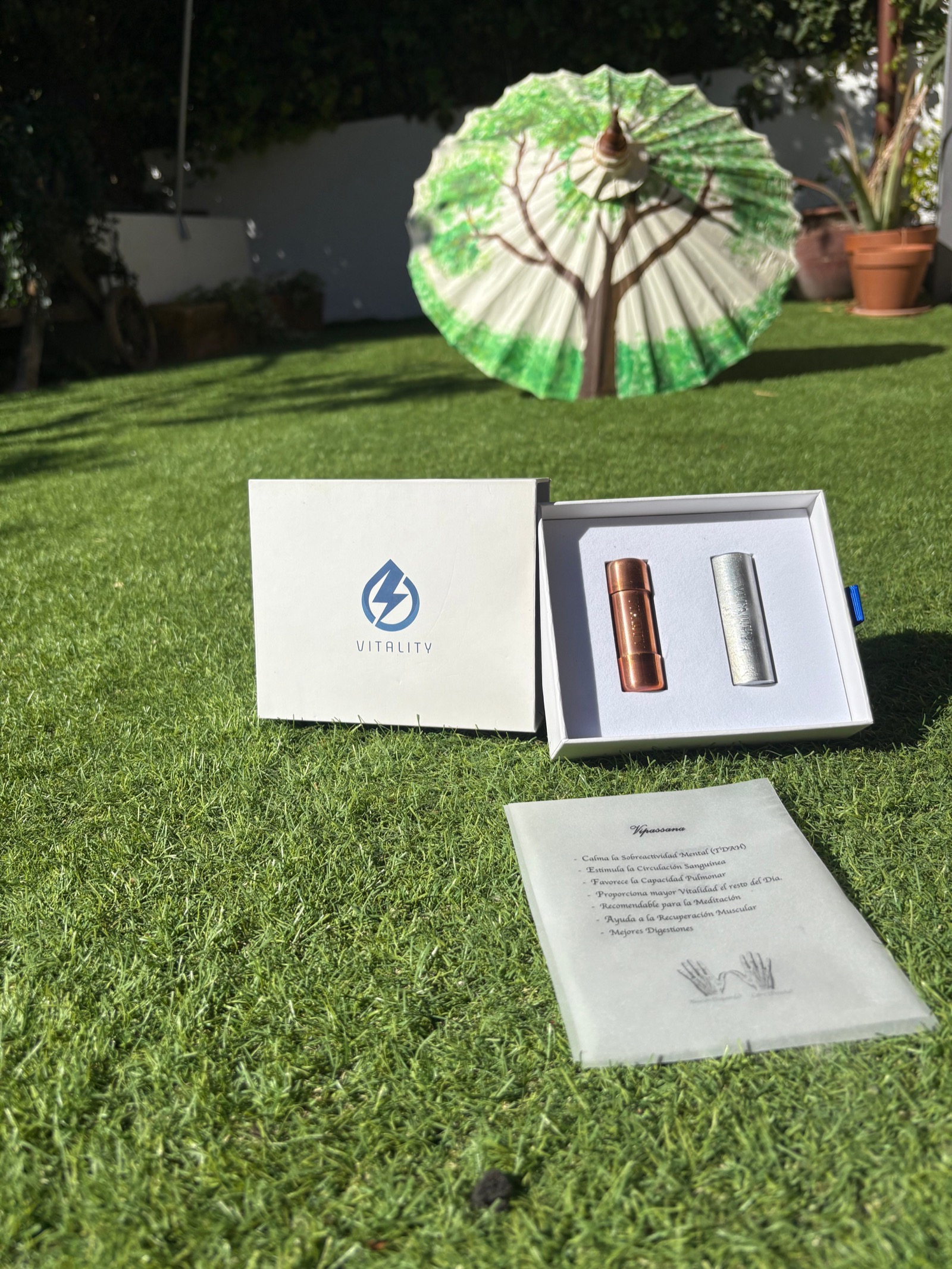
Vipassanna works like a galvanic cell: two different biocompatible metals and the moisture of your skin as electrolyte form a pair of about 1.1 V. No batteries: the cell forms when it touches the skin.
Vipassanna is a bioelectric reconnection device: its galvanic pair of biocompatible metals (about 1.1 V of potential) generates a microcurrent on contact with the skin, with no batteries or plug.
2 · Cells
Every cell runs on its own voltage
The electrical potential of the membrane is not exclusive to neurons and muscles. A 2014 review brings together the evidence, in animal models, that the voltage of each cell acts as a signal that regulates its behavior and the organization of whole tissues.
In rat skin, direct currents of between 10 and 1,000 microamps increased the tissue's ATP (the molecule cells use as energy) and the incorporation of amino acids into proteins. Put simply: in that experiment, a very small current made the tissue produce more energy. It is a laboratory and an animal, with applied current. It has not been checked whether Vipassanna's current is comparable.
3 · Blood vessels
Blood vessels respond to electric fields
In culture, endothelial cells (the inner layer of vessels) from bovine aorta migrated toward the negative pole of an applied electric field. The response appeared from 1 to 2 V/cm, similar to what is measured in living tissues. It is an in vitro experiment, not in people.
4 · Nerves and muscle
One microcurrent session: more leg endurance than with placebo from age 65 on
The signal of nerve and muscle is electrical: in 1952 it was described how current across the membrane explains the nerve impulse, and a 2005 review notes that direct-current electric fields are present in developing and regenerating tissues and influence cell behavior.
In a randomized, double-blind trial with 38 healthy people aged 65 or older, after a single 40-minute microcurrent session the real group increased its grip strength and its number of heel raises relative to baseline, and outperformed the sham group in heel raises and in total test time. For grip strength, the abstract does not compare the groups with each other.
5 · Muscles
Less delayed-onset muscle soreness (DOMS) and strength preserved after exertion
Double-blind, placebo-controlled trial in 30 healthy men after an exercise that damages the arm muscle: the placebo group lost up to 25% of strength in the elbow flexors in the first 48 hours; the group that wore a microcurrent membrane for 96 hours maintained it, and its creatine kinase (a marker of muscle damage) peak was 777 versus 1,918 U/L.
Two randomized trials with a sham device, 18 trained men each, 3 hours a day for 8 weeks. In the strength one, only the microcurrent group had less soreness at 12, 24 and 48 hours and improved its vertical jump, although the authors conclude it added no significant performance benefit. In runners, less soreness at 24 and 48 hours and the same aerobic speed improvement in both groups.
6 · Summary
What they recorded with microcurrent
Strength preserved after exercise that damages muscle, less delayed-onset muscle soreness (DOMS), more leg endurance than with placebo in people over 65 and a feeling of more rest: that is what five microcurrent trials in people recorded. The last one, a crossover study with 20 men, was not double-blind and, according to a 2025 correction, only one of its two authors declares no conflicts of interest.
Four of those trials used devices that apply a controlled current and the fifth a membrane with electrostatic charge. Vipassanna generates its microcurrent through a galvanic pair on contact with the skin and it has not been measured whether it is comparable: none of these studies evaluates it or demonstrates a benefit of it in people.
Vipassanna is a bioelectric reconnection device: its galvanic pair of biocompatible metals (about 1.1 V of potential) generates a microcurrent on contact with the skin, with no batteries or plug.
Vipassanna is not a medical device and does not replace the advice of a healthcare professional.