Grounding and sleep: as far as we know, there are two studies in people that measured sleep, one without a control group and the other with a placebo group.
The evidence is scarce and uneven, and we'd rather say so from the very first line. Grounding (also called earthing) means keeping the body in electrical contact with the Earth, either directly or through a conductive product, such as a sheet, connected to an earthed socket. At Vitality Life Balance we separate what was measured from what participants perceived, we flag the design of each study and we spell out what's missing before any conclusions can be drawn. Everything that follows is general information, not a promise of results.
What studies exist on grounding and sleep?
As far as we know, there are two studies in people that measured sleep: a pilot with 12 adults and no control group (Ghaly and Teplitz, 2004) and a 2025 Korean trial with a placebo group (Park et al.). We add a muscle-recovery trial with a sham sheet and a study in rats. The evidence is still preliminary.
We looked up each study by title, DOI or PMID in PubMed, Crossref and the journals themselves (searched in October 2026).
| Study | Who | Design and control | What it measured | What it tells us |
|---|---|---|---|---|
| Ghaly and Teplitz (2004), J Altern Complement Med (PMID 15650465) | 12 adults with sleep, pain and stress complaints | Before-and-after pilot, 8 weeks, no control group | Salivary cortisol (measured) and sleep, pain and stress (self-reported) | The authors observed lower night-time cortisol and participants reported improvements. It can't separate a real effect from expectation |
| Park et al. (2025), Adv Integr Med 12(3):100458 (DOI 10.1016/j.aimed.2025.01.005; no verified PMID) | Participants in the Korean trial at Kyung Hee University | Randomised, double-blind and placebo-controlled according to its authors; grounding mat versus an unconnected mat, 6 h a day for 31 days | Sleep (PSQI, ISI), daytime sleepiness (ESS) and stress (BEPSI) by questionnaire, and total sleep time by actigraphy, on days 0, 31 and 38 | The authors report before-and-after improvements in the experimental group and, versus the control, longer total sleep time and a better ISI questionnaire score at the day-38 measurement. It is a single trial, with a mat and no known replication |
| Müller et al. (2019), Front Physiol (PMID 30745882) | 22 healthy adults | Randomised, connected sheet (n=12) versus sham sheet (n=10), 10 days | Muscle recovery after a downhill run. It did not measure sleep | It uses the night as the time of connection, but says nothing about sleep |
| Ye et al. (2024), Int J Mol Sci (PMID 39337279) | Rats | Animal study, connected mat for 7 and 21 days | Brain activity (EEG) and markers in the brain | It suggests a line of research; it says nothing about people |
The full references and the rest of the studies are in our review of grounding studies (in Spanish).
What exactly did the 2004 study on sleeping grounded measure?
Ghaly and Teplitz (2004) measured cortisol in saliva over 24 hours and collected, through a daily log, how participants perceived their sleep, pain and stress. Because it had no control group, the study can't tell a real effect of grounding apart from the expectation of the people trying it.
According to the abstract on PubMed, participants slept for eight weeks on a conductive mattress pad connected to earth, and the authors describe a cortisol profile that tended to normalise and less night-time cortisol.
Here it's worth separating two levels:
- What was measured: salivary cortisol. It's a physiological data point, and that's why it's the most interesting part of the study. Even so, it's a single follow-up measurement.
- What was perceived: sleep, pain and stress, recorded as self-reports. It's valuable information, but very sensitive to expectation: if you expect to sleep better, you may notice it even if nothing changes.
That study did not measure sleep with actigraphy or polysomnography, which are the objective tools. Nor have we been able to consult the full text, so we can't say anything about its funding or conflicts of interest. What we do know is that some of the most cited research on grounding is signed by authors who declare links with a company in the sector, something we explain in our analysis of whether grounding is real or placebo.
What did the 2025 Korean trial with a placebo group measure?
Park et al. (2025) compared a grounding mat with an unconnected one, used 6 hours a day for 31 days, and measured sleep, sleepiness and stress by questionnaire (PSQI, ESS, BEPSI, ISI) and sleep time by actigraphy. The authors report, versus the control, longer total sleep time and a better ISI questionnaire score at the day-38 measurement.
On paper, it's the most complete design of those we've reviewed: according to its authors, it was double-blind against an unconnected mat, and it combines questionnaires with an objective measure (actigraphy). That doesn't make its results proof, and it's worth reading with caution:
- It used a mat, not a sheet. And a product that isn't from Vitality Life Balance: its results can't be carried over to any specific product, ours included.
- It's a single trial. As far as we know, it hasn't been replicated by another group.
- The results are those reported by its authors. Before giving them weight, the sample size, funding and possible conflicts of interest need to be checked in the full text.
- Two differences versus the control, in a single trial, don't amount to a demonstrated effect. What's more, most of the measures are questionnaires, the ISI included, and they're sensitive to expectation even with a placebo group.
What other studies link earthing and sleep?
Apart from Ghaly and Teplitz (2004) and Park et al. (2025), the studies usually cited on earthing for better sleep are Müller et al. (2019), a trial with a sham sheet that measured muscle recovery, not sleep, and Ye et al. (2024), done in rats, which doesn't allow conclusions about people.
Müller et al. (2019). A team at the University of Salzburg randomly assigned 22 healthy adults to sleep for ten nights on a connected or sham conductive sheet, after an intense downhill run. It measured muscle soreness, creatine kinase and physical performance, not sleep. We cover that side in grounding and athletes (in Spanish).
Ye et al. (2024). Published in International Journal of Molecular Sciences, it studied rats on a connected mat for 7 and 21 days and analysed their brain activity with EEG. It's preclinical: useful for raising hypotheses, not for knowing what happens in a human bedroom.
We've left out a pilot in patients with a specific disease, because it can't be extrapolated to the general population.
What would a good study on grounding and sleep look like?
A good study would compare people sleeping on a connected product with others using an identical but sham one, without them or the people analysing the data knowing who is who. It would measure sleep with objective devices, recruit more participants and be run by a team with no commercial ties to the sector.
Specifically, it would need:
- A blinded sham group. An identical sheet or mat that doesn't connect to earth, so that expectation affects everyone equally.
- An objective measure of sleep. Actigraphy or polysomnography, as well as questionnaires.
- A larger sample. With few people, individual variation can explain almost any result.
- Independence. A team with no shares, contracts or products to sell.
- Replication. Another group repeating the experiment and getting compatible results.
The 2025 Korean trial meets the first two points as described by its authors. Sample size and independence need to be checked in the full text, and replication doesn't exist yet. That's why, as far as we have been able to verify, no study today meets all five points at once. That doesn't mean grounding can't have an effect: it means it hasn't yet been tested with enough rigour to claim it. Independent sources agree that the evidence is limited, such as the Sleep Foundation guide to grounding sheets or the analysis published by Snopes in June 2026, whose headline says the evidence is scarce.
Does it make sense to try a grounding sheet knowing this?
Trying a grounding sheet is a personal decision that doesn't depend on a promise of results. If your rest worries you, start with sleep hygiene: regular hours, a dark and cool bedroom and less screen time at night. If you then want to try grounding out of curiosity, it's a simple practice with no batteries.
If you decide to do it, there are two practical points. The first is checking that the connection really works, because a product that isn't connected to a proper earthed socket doesn't do its job of connecting; the second is not expecting a specific effect or a specific timeframe. If the set-up raises doubts, we go over the most common causes of a set-up with no real earth. On safety, night-time use is explained in whether grounding sheets are safe. And if what brings you here is a sleep problem that drags on, talk to a healthcare professional; you'll find more ideas in our guide to habits and routines for rest (in Spanish), without replacing that consultation.
The limits of the evidence
The evidence on grounding and sleep is preliminary, and these are the reasons:
- Few studies and no replication. As far as we know, only two studies in people measured sleep and neither has been repeated by an independent group.
- Small or unconfirmed samples. The 2004 pilot included 12 people; for the Korean trial, the sample size should be checked in the full text.
- No control group and self-reports in the pilot. A real effect can't be told apart from expectation, and sleep was recorded according to participants' perception.
- Questionnaires sensitive to expectation. Even with a placebo group, a good share of the measures in the 2025 trial are subjective; actigraphy is the exception.
- Conflict of interest in the field. Several highly cited authors in the earthing literature declare links with a company in the sector. It doesn't invalidate their data, but it makes independent replication necessary.
- The leap from animals to people. What was observed in rats can't be taken as valid in humans.
Conclusion
The answer on grounding and sleep is still provisional: a pilot without a control group, a single Korean trial with a mat and a placebo group whose results, as reported by its authors, await replication, a muscle-recovery trial and an animal study. It's a line of research that deserves independent replication, not a settled conclusion. The sensible thing is to stay informed and keep expectations realistic.
If you decide to try it, the Vitality Life Balance grounding sheet is used like any fitted sheet and comes with a tester to check the connection.
Frequently asked questions (FAQ)
Does sleeping grounded lower cortisol?
In the only study in people that we have been able to verify that measured cortisol (Ghaly and Teplitz, 2004, J Altern Complement Med, 12 adults), the authors observed lower night-time cortisol. It's a preliminary finding, from a small sample and without a comparison group, so it doesn't allow us to claim that grounding lowers cortisol in general.
Are there placebo-controlled trials on grounding and sleep?
There's one from 2025, carried out in Korea with a mat (not a sheet), which its authors describe as randomised, double-blind and placebo-controlled (Park et al., Adv Integr Med, DOI 10.1016/j.aimed.2025.01.005). They report, versus the control, longer total sleep time and a better ISI questionnaire score at the day-38 measurement. It's a single trial, with no known replication. The sham-sheet trial by Müller et al. (2019) assessed muscle recovery, not sleep.
Does grounding replace treatment for poor sleep?
No. Grounding is not a medicine or a medical device, and no verified study presents it as an alternative to medical care. If you have persistent sleep problems, talk to a healthcare professional before changing your routines or your medication.
How many studies are there on grounding and sleep in people?
That we have been able to verify, two that measured sleep: Ghaly and Teplitz (2004), with 12 adults and no control group, and Park et al. (2025), a Korean trial with a placebo group. There's also a sham-sheet trial (Müller et al., 2019) on muscle recovery. It's preliminary evidence: it doesn't allow us to claim that grounding improves sleep.
References
Reviewed by Lucas Calderón de la Barca, founder of Vitality Life Balance.
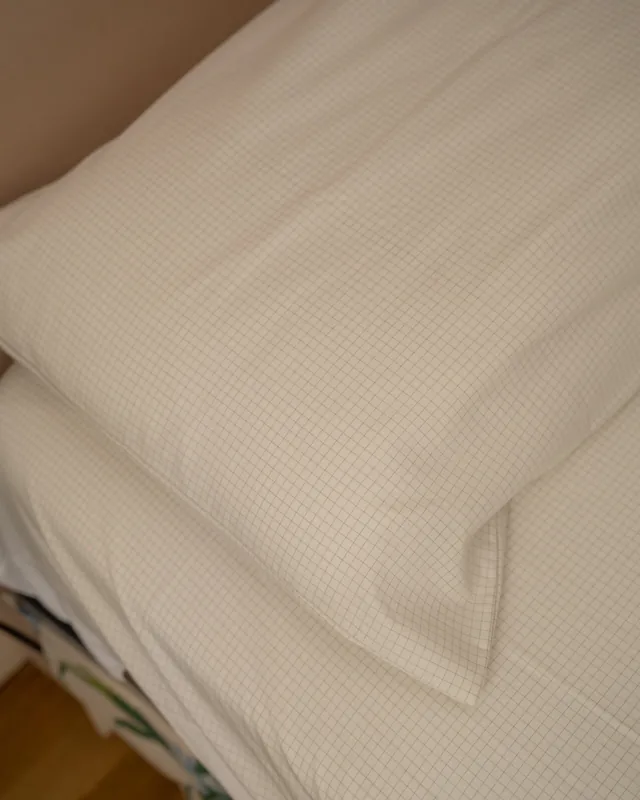
If you'd like to try it with a verified connection: Vitality Life Balance grounding sheet, from €99.99. No promises of results: it's a fitted sheet that connects to earth and includes a tester to check it.
Keep reading on Vitality Research
What it means for grounding to “work”, the level of evidence for each use and the three most common causes of “I don't notice anything”.
The verified peer-reviewed studies, with full references.
The real studies, their methodological limits and the conflict of interest declared by the authors.
What you need to know about night-time use and set-up.