Five steps: use the No. 2 tester to confirm the wall socket has a real earth, lay the sheet conductive side against your skin, clip the cable to the snap stud, plug the cable into the earth adapter, and plug the adapter into that same tested socket. Testing before connecting is the safest order.
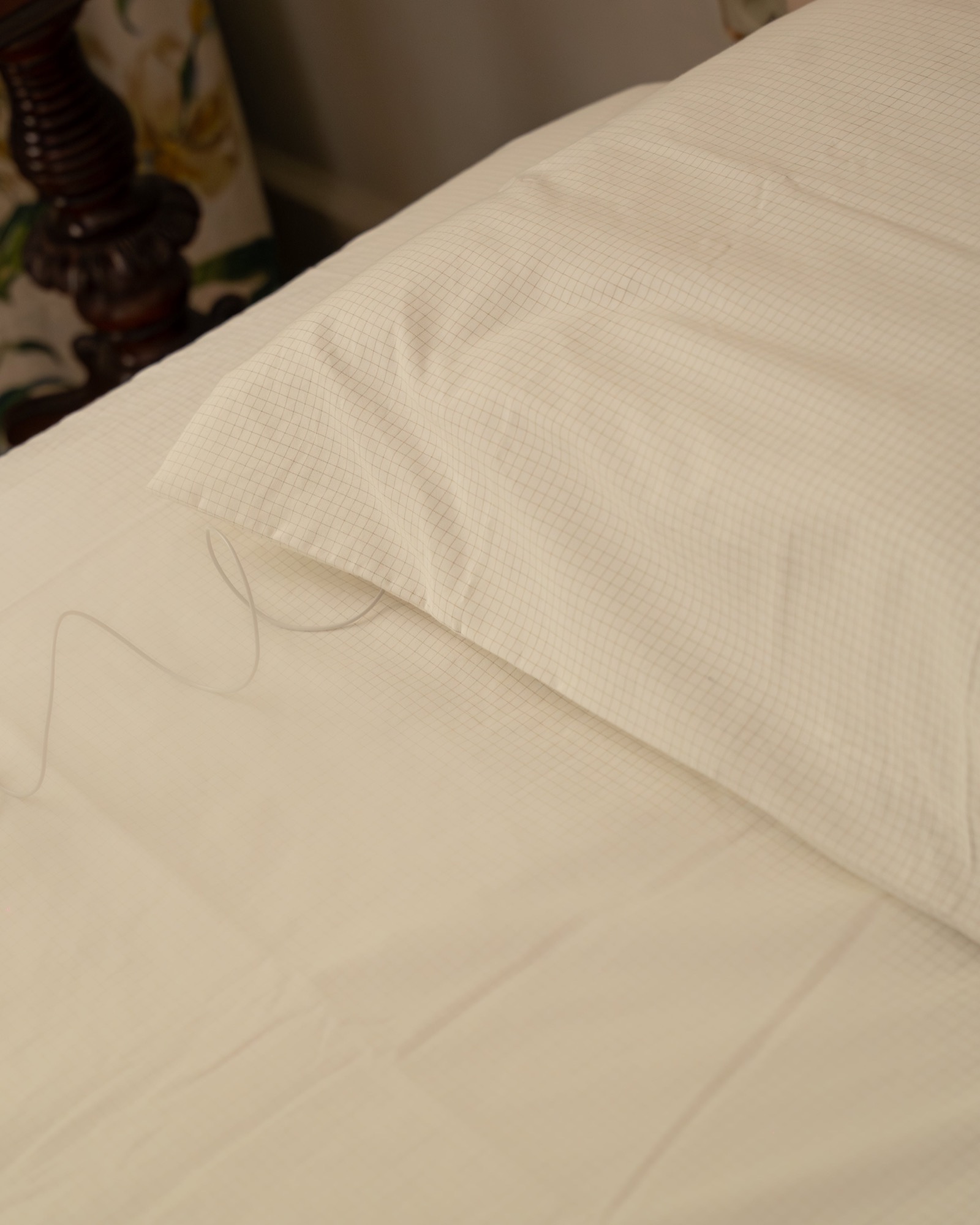
Your grounding sheet has arrived and you're staring at a Schuko socket wondering what plugs into what. The short answer is three moves: clip to the sheet's snap stud, cable into the earth adapter, adapter into a wall socket with a real earth. The entire difficulty of the job lives in those last three words. This guide doesn't argue about whether grounding works (that's whether grounding sheets actually work) or whether sleeping grounded carries any risk (we cover that in the risk scenarios of sleeping grounded, one by one). Here we're just plugging it in properly.
How do you connect a grounding sheet to a Schuko socket, step by step?
Five steps: first, use the No. 2 tester to confirm the wall socket has a real earth; then lay the sheet conductive side against your skin, clip the cable to the snap stud, plug the cable into the earth adapter and plug the adapter into that same tested socket. Testing before connecting is the safest order.
- Plug the No. 2 tester into the wall socket you plan to use and confirm the earth works. Do this before you connect anything else: it's the safety check that stops you plugging a €99.99 sheet into a socket with no real earth behind it.
- Lay the sheet with the conductive side facing up, in direct contact with your skin. Put another sheet or a cover between your body and the conductive surface and you've insulated yourself — the contact is gone.
- Push the cable clip onto the metal snap stud on the sheet until it sits firmly. A loose clip is the silliest — and most common — reason people say they “don't feel anything”.
- Plug the other end of the cable into the earth adapter.
- Plug the adapter into that same tested wall socket. Straight into the wall, not into an extension lead or a multi-plug: every extra link is one more place where the earth connection can quietly disappear.
Does the sheet's orientation or the cable side matter?
No. Run the cable out of whichever side sits closest to the socket in your room. There's no polarity in an earth circuit, so no side is “the right one”. Pick whatever is most comfortable and leaves the cable slack rather than pulled tight or trapped under the mattress.
Worth knowing: the same procedure — clip, cable, adapter, socket with a real earth — applies identically to the rest of the grounding range: mat, blankets and pillowcases. The product changes, the method doesn't.
How does a grounding sheet's plug adapter work?
The adapter is really an earth-only plug: the live and neutral pins are non-conductive plastic and exist purely so the piece fits and stays put in the socket. Only the earth contact — metal — makes a real electrical connection. That's why the adapter draws no electricity and doesn't “switch on” anything.
That single fact settles most of the questions people have the first time they see one:
- It uses no electricity and won't show up on your bill. There's no closed live-neutral circuit, so there's no consumption to measure.
- In a correctly wired socket, no current flows to the sheet. The adapter doesn't “electrify” anything: it simply brings the conductive surface to the same earth potential as your home. One more reason to test the socket rather than assume it's fine.
- It doesn't matter if that socket is controlled by a switch that's off. The earth contact of a Schuko socket doesn't depend on the live switch: it's still earth whichever way the switch is flipped.
- Nothing needs to be left “on” overnight for the system to work.
This mechanism is documented in Groundology's technical sheet and user guide for their earth connection adapter (Earth Connection Plug EU) — we cite it as documentation from an established manufacturer in the sector, not as an independently verified technical standard.
Does the cable have any protection built in?
Yes: the cable that connects the sheet to the adapter has a built-in safety resistor, designed to limit current flow in the event of accidental contact with a live conductor. On the Vitality Grounding Sheet cable we measured it ourselves and it comes in around 100 kΩ — that's our own measurement, not an external certification — and other manufacturers in the sector declare values of the same order in their product sheets. That resistor is why the product is designed to be used at home without touching the electrical installation, though no protection replaces a socket in good condition: hence our insistence on testing the socket first. For the same reason, never make a homemade cable or run a bare wire straight to earth: you'd lose that protection. If you want to understand why this matters, read the real risks of sleeping grounded, scenario by scenario.
Where is the earth on a Schuko socket?
On a Spanish Schuko socket (Type F), the earth is the two flat metal clips on the sides of the socket face — not the two central holes, which are live and neutral. The adapter meets those side clips as it goes in, and that's where the earth connection is made.
Now the important caveat: a socket having those visible side clips does not guarantee there's an earth wire actually connected behind them, running back to your home's main installation. How it looks is not how it works. A socket can look perfectly normal and have no working earth at all, especially in older buildings.
So how do you confirm your socket has a real earth? The No. 2 tester in the box gives you a first answer the moment you plug it in, before you connect anything else. For a deeper check afterwards, multimeter included, there's the test for whether your socket has a real earth connection.
What if my Schuko socket has no real earth?
With no real earth, the product has nowhere to drain charge to: the problem isn't the sheet, it's the wiring of that particular socket. Start by trying other sockets around the home — it's common for only some circuits to have a working earth. If none of them do, there are two honest ways out.
The first is having a certified electrician inspect the installation and, if needed, fit a working earth. Spanish electrical regulations (the REBT, the low-voltage electrotechnical regulation) require earthing in new or refurbished installations; older housing stock that has never been rewired may not have it, and only a professional can resolve that. Ask them directly whether your installation complies.
Some installation companies quote indicative cost ranges running, depending on the scenario, from €120 to €400 — that figure comes from an external commercial source, not from Vitality, and only as a reference so you know what to expect from a quote. Always get a fixed quote before hiring anyone.
The second way out, if you'd rather not have work done, is the outdoor grounding rod we describe further down.
What you must never do, however often you've seen it suggested on a forum: connect the earth cable to neutral, use a water pipe as an earth, or accept a socket that has an earth hole but no wire actually connected behind it. Domestic electricians cite those three as the most dangerous shortcuts precisely because they don't solve the problem and can create a new one. This is your home's wiring, not the grounding product: if in doubt, ask a certified electrician before touching anything.
My socket doesn't have three contacts — can I still use a grounding sheet?
No, and the honest answer is exactly that blunt: with no third contact there's no earth to connect to, and no format-conversion adapter creates an earth that physically doesn't exist. A “universal” adapter may fit the socket perfectly, but fitting is not the same as having continuity to earth.
This is the case with old two-pin sockets (Type C, or Europlug), with two round holes and no side clips. They're still around in plenty of older Spanish buildings, often alongside modern Schuko sockets in the same flat — typically the living room has been refurbished and the guest bedroom hasn't.
If that's your socket, you have three practical options: use another socket in the home that does have an earth (even if that means moving the bed a few metres or using an extension lead that does carry an earth conductor all the way through), ask an electrician to inspect and upgrade that point of the installation, or fall back on the outdoor grounding rod we cover next.
Can I plug a grounding sheet into an extension lead or a multi-plug?
Only if that extension lead carries an earth conductor and passes it through to the final outlet where you plug the adapter in. It's a detail that's easy to miss: not every extension lead or multi-plug — especially the cheapest ones — has an earth on all its outlets, or on any of them. And if the extension lead breaks the earth, your sheet is only connected in appearance.
With no tools, you can do a first visual check: look at the extension lead's own plug (the one going into the wall) for the metal side clips, and check that each of its outlets has them too. A properly three-conductor lead is a sign the earth circuit can reach the end — though, as with the wall socket, looks don't guarantee it a hundred per cent.
Which is why our house recommendation is simple: plug the adapter straight into the wall socket whenever you can. One link fewer in the chain is one failure point fewer.
If you've been using the sheet through an extension lead for a while and feel like “nothing is happening”, that lead is the first suspect — well before concluding the product doesn't work. We go through more cases like it in what to check when you've set everything up and still feel nothing.
How do you connect a grounding sheet without a socket? The outdoor grounding rod
If you have no real earth at home and don't want building work, there is an alternative: drive a metal rod into damp soil outside — a garden, a terrace with natural soil, never concrete and never a plant pot — and connect it with a long cable (commercial kits are typically around 12 metres) run in through a window to your sheet, mat or blanket. That bypasses your home's electrical installation entirely.
That cable has to be the one from the kit itself, with its built-in safety resistor: the rule about not improvising a bare wire to earth applies here too.
The method is documented by international brands in the sector such as GroundLuxe and Earthing.com. Vitality does not manufacture or sell this type of rod, and we're telling you that with the same honesty as everything else in this guide.
The limitations are real and worth knowing before you commit:
- You need access to natural soil. A concrete balcony, a paved terrace or a plant pot won't do.
- The ground needs to be reasonably damp to conduct well; in very dry spells the system loses effectiveness.
- A cable crossing a window or door every day is a genuine inconvenience, not just an aesthetic one.
- You should disconnect the rod during thunderstorms, for the same reason any outdoor earth connection should be disconnected in those conditions. We explain it in detail in what to do if a thunderstorm catches you with the rod connected.
We describe the method so you know it exists and what it involves, but we don't give installation instructions: putting up a grounding rod safely is your job or your installer's, and if you have any doubt, a certified electrician's.
How do I check the connection is right?
You already used the No. 2 tester in step 1, before connecting anything, to confirm the wall socket had a real earth. The No. 1 tester — the other one in the box — is run across the fabric surface and is there for periodic checks, for example after several washes. If you want to confirm the whole system with more precision, a basic multimeter costing around €10 does it better: the step-by-step protocol is in our guide to checking whether your grounding sheet actually works.
Common mistakes when connecting a grounding sheet
Most setups that “don't work” have one of these six faults, not a problem with the product:
- Putting another sheet or cover over the conductive surface — it insulates you and cancels skin contact.
- Plugging into an extension lead with no earth conductor — the connection exists in appearance only.
- Accepting a socket just because the adapter physically fits — fitting is not the same as having a working earth behind it.
- A badly seated clip on the snap stud — it creates an intermittent contact that comes and goes without you noticing.
- Using a homemade cable or a wire straight to earth — never. You lose the protection of the original cable.
- Using a travel or format-conversion adapter to “create” an earth — no adapter generates an earth where there isn't one.
Some of the real user complaints we've audited about “not feeling anything” trace back to one of these six points, not to a manufacturing fault.
Summary: what to do based on your socket type
This table condenses the five socket situations this guide covers and the honest way out of each. Use it as a quick reference before buying tools or calling an electrician.
| Your situation | Real earth? | What to do | Indicative cost |
|---|---|---|---|
| Schuko socket (3 contacts) with earth verified by multimeter | Yes | Adapter plugged straight into the wall socket | €0 — included with the product |
| Schuko socket with side clips but no working earth behind them | No | Certified electrician inspects and fits an earth, or outdoor grounding rod | €120-400* for the electrician's work |
| Old two-pin socket (Type C / Europlug, 2 round holes) | No | Use another socket in the home with an earth, upgrade the point with an electrician, or outdoor rod | Depends on scope of work |
| Extension lead or multi-plug with no earth conductor on all outlets | No, even when it looks like it | Plug the adapter straight into the wall socket, not into the lead | €0 |
| No earth on any socket in the home | No | Outdoor grounding rod driven into damp soil, cable run to the product | Cost of the kit (~12 m cable + rod) |
*Figure from an external commercial source, not from Vitality; always get a fixed quote before hiring.
The limits of this guide (what we can't resolve here)
We want to be as honest about this guide's limits as we are about everything else. This piece does not replace a certified electrician: we can't diagnose the state of your installation remotely, and we're not authorising you to work on it. The adapter mechanism we describe comes from manufacturer documentation in the sector, not from a technical standard we've independently verified clause by clause. The cost ranges for installing an earth connection are indicative and come from an external commercial source, not from Vitality. And finally, this guide is about electrical installation, not about grounding efficacy or clinical safety: for those questions you have whether grounding sheets actually work and whether it's dangerous to sleep grounded.
Frequently asked questions
How do you connect a grounding sheet to a socket in Spain?
First plug the No. 2 tester into the wall socket and confirm it has a real earth. Then clip the cable onto the sheet's snap stud, plug the other end into the earth adapter, and plug the adapter into that same tested socket.
Does a grounding sheet adapter use electricity?
No. The adapter is an earth-only plug: its live and neutral pins are non-conductive plastic and only the earth contact makes a connection. It draws no power and, in a correctly wired socket, it carries no current to the sheet.
Where is the earth on a Schuko socket?
It is the two flat metal clips on the sides of the socket face, not the two central holes, which are live and neutral. Those clips existing does not guarantee there is an earth wire connected behind them: that has to be tested.
My socket only has two round holes — can I use a grounding sheet?
No. An old two-pin socket has no earth contact, and no adapter creates an earth that isn't there. Use another socket in the home that does have one, or ask a certified electrician.
Can I plug a grounding sheet into an extension lead?
Only if the extension lead carries an earth conductor all the way through to the final outlet; many cheap ones don't, and the connection fails silently. Whenever you can, plug the adapter straight into the wall socket.
Can I use a grounding sheet if my home has no earth connection?
Not through the socket. The two options are having a certified electrician install a working earth, or using an outdoor grounding rod driven into damp soil and connected by cable to the product.
Conclusion
In the end, connecting a grounding sheet in Spain comes down to three moves — clip, cable, adapter — and one condition that has to be genuinely met: a Schuko socket with a real earth, plugged straight into the wall. Every “awkward” scenario in this guide — socket with no earth, old two-pin socket, extension lead that breaks the circuit, or no usable socket at all — has an honest way out, even if it isn't always the quickest one.
If you've just bought or you're about to, our Vitality Grounding Sheet (€99.99) ships with cable and testers included, so you can verify the connection from day one without buying anything else. See the Vitality Grounding Sheet. If you'd rather start with another piece of the range — mat (€160), blankets (€100) or pillowcases (€50) — the connection method is identical across the whole Vitality grounding range.
A separate note for anyone looking for grounding with no cable involved at all: the Vipassanna (€199) doesn't connect to the mains and has no adapter, so none of the scenarios in this article apply to it. That's a design difference, not a promise of a different outcome.
This guide is informational and does not replace assessment by a certified electrician. If you have any doubt about the state of your home's electrical installation, don't work on the socket: consult a qualified professional before connecting any grounding product.
Reviewed by Lucas Calderón de la Barca, founder of Vitality Life Balance.
Keep reading on Vitality Research
The €10 multimeter test: fabric continuity, socket earth and body voltage.
Shock, thunderstorms, pacemakers, pregnancy and children: the 7 risk scenarios, one by one.
Why it works for some people and not others: the 3 real causes and what to actually expect.
Sheet, mat, blankets and pillowcases. The connection method is identical for all of them.