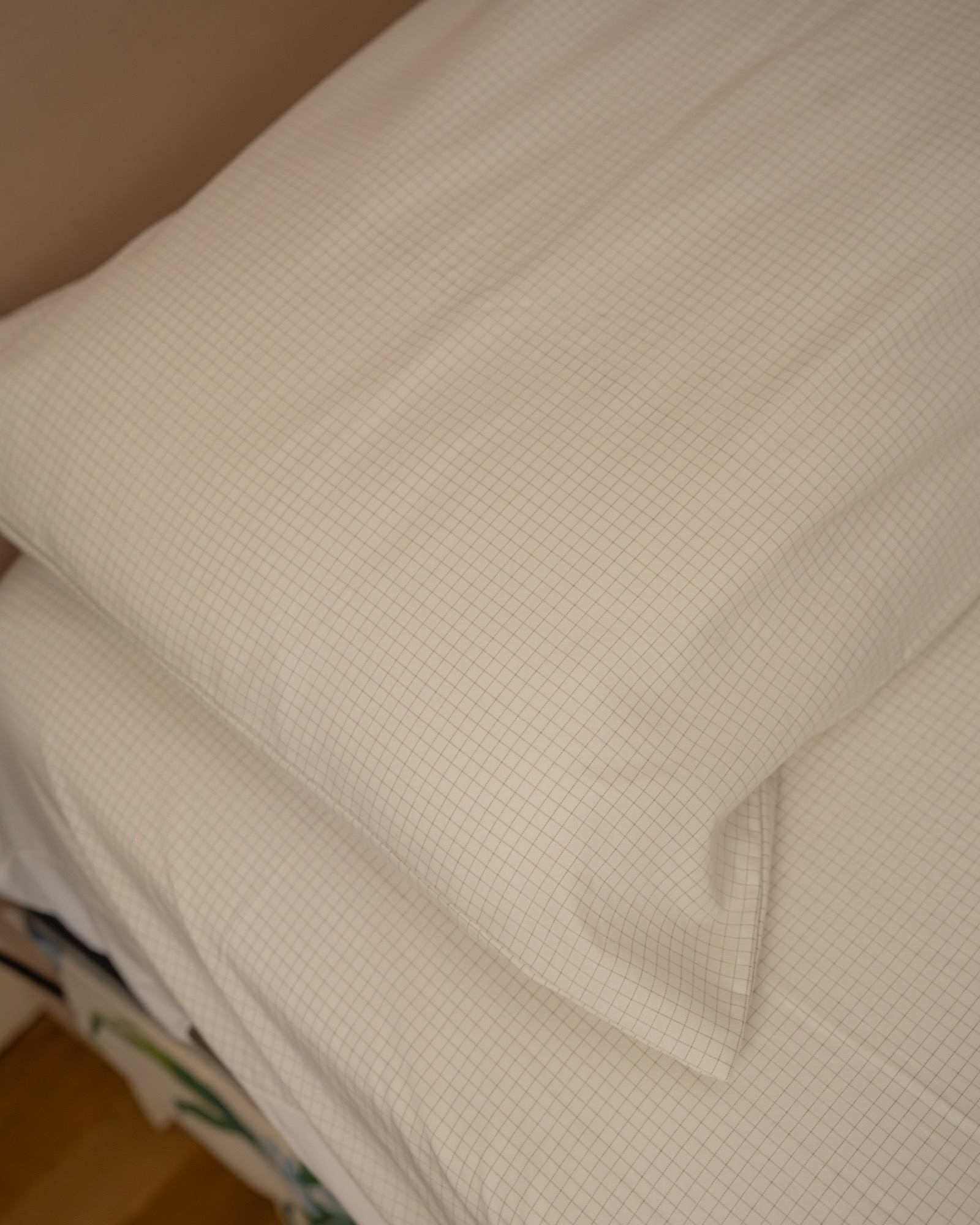
- On r/Earthing, r/biohackers and r/askscience the recurring debate isn't so much “does it work” as what the mechanism is and why the studies are so small.
- The best-argued sceptical criticisms are legitimate: small samples, the difficulty of genuine blinding, and conflicts of interest declared in several studies.
- What isn't in dispute is the electrical effect: with a real earth connection, the body takes on the earth's reference potential, and that can be measured with a voltmeter.
- The materials debate gets threads of its own: silver conducts roughly 45 times better than 316L steel; steel wins on durability and maintenance.
- The variable most often ignored before buying: whether the socket in your home has a real earth connection. Without one, the product does nothing.
What Reddit really debates about grounding sheets
If you search "grounding sheet reddit," "earthing sheets reddit," or "sábana grounding reddit" on Google, you land in threads on r/Earthing, r/biohackers, r/sleep, and r/askscience, where the community has been debating the topic for years. The debate patterns are consistent and keep repeating:
- The most recurring debate isn't "does it work" — it's "what's the mechanism" and why the studies are so small
- The materials question (silver vs stainless steel) generates its own threads, with durability and conductivity comparisons
- Organised scepticism comes mainly from r/skeptic and users with a physics background, who question whether electron transfer through the cable is biologically meaningful
- Biohacking community members tend to apply a "low risk, potential benefit, personal experiment" framework before dismissing it outright
- The building's ground connection (whether the outlet has a real ground) comes up in many threads as a critical variable most people ignore
“The first step before buying any grounding sheet is checking that your outlet has a real ground connection. In older buildings in many cities, the third pin can be wired to neutral, or not connected at all. Without a real ground, the sheet does nothing — electrically, you're identical to sleeping without it.”
Synthesis of recurring arguments from public forums. Does not represent any verbatim comment from any identified user.
The two variables the community brings up most, and checks least before buying, are the conductive material and the earth connection. The Vitality sheet uses 5% silver thread and includes the tester so you can verify both.
View the Grounding SheetThe community's honest scepticism: legitimate criticism
Part of what makes the Reddit community useful is that not everyone is a believer. The most articulate, honest criticisms circulating in forums deserve to be gathered here, because they are legitimate criticisms, not emotional dismissals.
The real methodological problems with grounding studies
The scientific community and sceptical users consistently point to three problems:
- Small samples: Most positive studies have fewer than 20 participants. That limits statistical power and generalisability.
- No real blinding possible: Unlike a drug trial, the participant generally knows whether their sheet is grounded or not. This introduces expectancy bias into subjective measures like sleep quality or general wellbeing.
- Conflict of interest: Several of the most-cited studies have been partly funded by companies that sell grounding products, including work from Chevalier's own research group. Sceptics rightly flag this as a factor that requires independent replication.
These methodological problems are real. We don't downplay them. What sceptics can't dismiss with the same arguments is the electrical equipotential-bonding effect, which is physically real and measurable with a voltmeter: when the sheet is properly connected to ground, the body adopts the earth's reference potential (0V). What's under debate is the biological significance of that electrical change, not the physical phenomenon itself.
If you want to go beyond the Reddit threads and see the formal analysis of these same studies — including the conflict of interest several of their own authors disclose — we have a dedicated article that weighs the community's anecdotes against what the scientific evidence says about whether grounding is real or placebo.
And if what concerns you isn't the science in the abstract but your own experience, we have an article that answers head-on do grounding sheets really work? the real causes when you don't notice anything, with honest timelines and the three most common causes behind "it doesn't work".
What sceptics acknowledge does work
Even the most critical Reddit threads tend to acknowledge one point of agreement: inflammation markers are the strongest signal in existing studies. Chevalier et al.'s (2019, Frontiers in Physiology) meta-analysis shows reductions in C-reactive protein in grounding groups versus control. Subjective sleep, by contrast, is considered a weaker signal because it's highly susceptible to the placebo effect.
Silver vs steel: the technical debate that generates the most threads
If there's one technical debate that generates more threads than any other in the grounding community, this is it. The positions are clear, and there's real data to compare them.
| Feature | Silver (5%) | Stainless Steel 316L (30%) |
|---|---|---|
| Electrical conductivity | ~45x higher than steel Resistivity: ~1.59 × 10⁻⁸ Ω·m |
Lower initial conductivity Resistivity: ~7.2 × 10⁻⁷ Ω·m |
| Degradation after 50 washes | High-density silver (5-10%) degrades slowly; even degraded, it still conducts ~20x more than steel Only cheap, low-density silver loses 42-48% |
Doesn't degrade, but starts from 45x lower conductivity Maintains consistently low performance |
| Antimicrobial properties | Yes, a natural property of silver | Not applicable |
| Feel and comfort | Softer to the touch | Stiffer threads |
| Maintenance | Simple instructions (cold water, no bleach) — this is what preserves its superior conductivity | Standard washing (no premium conductivity to preserve) |
| Durability with correct use | Years of optimal performance with 5-10% silver thread and proper care Cheap silver lasts 12-18 months |
Very durable, but with consistently low performance |
| Value / performance ratio | Investment in superior conductivity and biocompatibility from the very first night | Cheaper, but less effective grounding throughout its whole lifespan |
The question the community debates has no universal answer. Biohackers who prioritise maximum initial conductivity prefer silver. Those looking for durability and minimal maintenance choose steel. The point Vitality argues — and backs with data — is that for nightly use on a sheet, initial conductivity matters more than extreme durability, because contact is direct with the skin for hours at a time.
Electrical conductivity isn't the only factor. The density of the conductive weave — the percentage of silver thread in the fabric — determines how much of the surface acts as a conductor. A sheet with 5% high-density silver holds its conductivity after washing better than one with 3% low-density silver, regardless of the base material.
For a more detailed technical breakdown with resistivity data and comparative conductivity studies, see our dedicated article: Silver vs Steel in Grounding Sheets: Technical Analysis with Data.
The community's most frequently asked questions
These are the most recurring points of debate that come up in grounding forums, biohacking communities, and wellness groups, answered honestly with technical data.
How to evaluate a grounding sheet: what experienced biohackers look for
The experienced biohacking community has more refined evaluation criteria than a first-time buyer. These are the points that show up in the most technical threads:
Verifiable conductivity
The sheet should come with a ground tester and a conductivity meter, or at least instructions to verify the connection with a multimeter. If a sheet doesn't let you verify that the circuit is closed, you don't know whether you're grounding or simply sleeping with a disconnected cable.
Real electrical conductivity, on a scale relative to new silver. Silver conducts ~45 times more than stainless steel — which is why, even after many washes, silver still far outperforms steel:
Specific, realistic washing instructions
Community threads about silver grounding sheets that degrade quickly share a common denominator: vague or ignored washing instructions. Silver oxidises on contact with bleach (hypochlorite) and loses conductivity at temperatures above 40°C/104°F. Any quality sheet should specify: maximum wash temperature, prohibited detergents (bleach, fabric softener), and maximum recommended washing frequency.
Quality cable and adapter
The most frequent point of failure isn't the fabric — it's the connection cable. The community reports problems with low-quality cables that lose continuity at the sheet's connector. A 4mm² cable with reinforced connectors and a secure banana-plug end for the outlet is the standard the most experienced users recommend.
Why Vitality uses 5% silver thread: the technical reasoning
We know the market has shifted toward stainless steel, driven by a durability argument. Vitality's decision to stick with 5% silver thread responds to specific reasoning we lay out transparently so you can evaluate it yourself:
- Nightly use prioritises initial conductivity: In a bed sheet, skin contact is direct and prolonged (6-8 hours). Maximum initial conductivity is the most relevant parameter for this specific use case.
- 5% high-density silver vs lower densities: The key isn't just the stated percentage but the density of the conductive weave. A well-distributed 5% at high density holds its conductivity through washes better than lower percentages spread thinly.
- Antimicrobial properties: For fabric in direct contact with skin during sleep, silver's antimicrobial activity is a real added benefit — ionic silver disrupts the cell membrane of bacteria and fungi, which is relevant for bedding hygiene.
- Biocompatibility: Silver has a documented history of biocompatibility in medicine (silver dressings, sutures) that stainless steel doesn't have to the same degree for prolonged skin contact.
Long-term durability (3+ years) is a point where stainless steel outperforms silver under the realistic washing habits of the average user. If silver's specific maintenance requirements (40°C/104°F, no bleach, no fabric softener) don't fit your routine, a high-density steel sheet may perform better in practice. We'd rather you make an informed decision than buy our product and end up disappointed by poorly managed expectations.
Where to research on your own: reliable sources
We value you doing your own research before buying. These are the sources we consider most useful and honest, both supportive and critical:
Open-access scientific studies
- PubMed / NCBI: Search "earthing grounding" or "grounding electron transfer" — you'll find the primary studies directly, with no intermediaries
- Chevalier G. et al. (2012) — Journal of Environmental and Public Health. DOI: 10.1155/2012/291541. Open access.
- Oschman JL et al. (2015) — Journal of Inflammation Research. DOI: 10.2147/JIR.S69656. Open access.
Critical perspectives worth reading
- Science of the Foot — "Grounding in Controversy": a critical analysis of study methodology
- r/askscience on Reddit: search "earthing grounding" to find answers from users with physics and biology backgrounds evaluating the mechanism
Communities for real experiences (not advertising)
- r/Earthing — a dedicated community, a mix of believers and constructive sceptics
- r/biohackers — more experimental, data-driven focus
- r/sleep — perspective from the sleep-quality angle
Reddit and biohacking forums are valuable sources of collective experience, but they aren't scientific research. Treat individual experiences as hypotheses that tell you which variables to track when you run your own trial — not as evidence of effectiveness or ineffectiveness for you specifically.
More resources from Vitality Research
If you found this article useful, here are the most directly related resources in our knowledge base:
Founder of Vitality Life Balance and BioWell (bioquantum) accredited. He has spent years testing and measuring grounding equipment, and writes based on the published grounding studies, limitations first. He is not a healthcare professional: this content is informational and does not replace medical advice. You can read his story here.